Overheating on a Classic Mini rarely starts with one dramatic failure. More often, it comes from a handful of tired classic mini cooling system parts all doing a slightly worse job than they should. A radiator that is partly silted up, a hose that has gone soft, a fan switch that is slow to react, or a water pump that looks fine until the engine is under load can all add up to a car that runs hotter than it ought to.
That is why it pays to look at the system as a whole rather than swapping one item and hoping for the best. On a standard road car, the cooling setup is simple and effective when everything is in decent order. On a tuned engine, in traffic, or during summer use, small weaknesses show up quickly.
What the classic mini cooling system parts actually do
The Classic Mini cooling system has a straightforward job. Coolant circulates through the engine, absorbs heat, then passes through the radiator where that heat is shed before the cycle starts again. The thermostat controls when coolant starts flowing through the radiator, and the fan helps pull air through when road speed alone is not enough.
In practice, each component affects the next. If the thermostat sticks, the radiator cannot do its job. If the hoses are collapsing internally, coolant flow suffers. If the radiator cap is weak, the system may lose pressure and run hotter. That is why chasing overheating by replacing the cheapest visible part is not always the best route.
The main cooling parts to check first
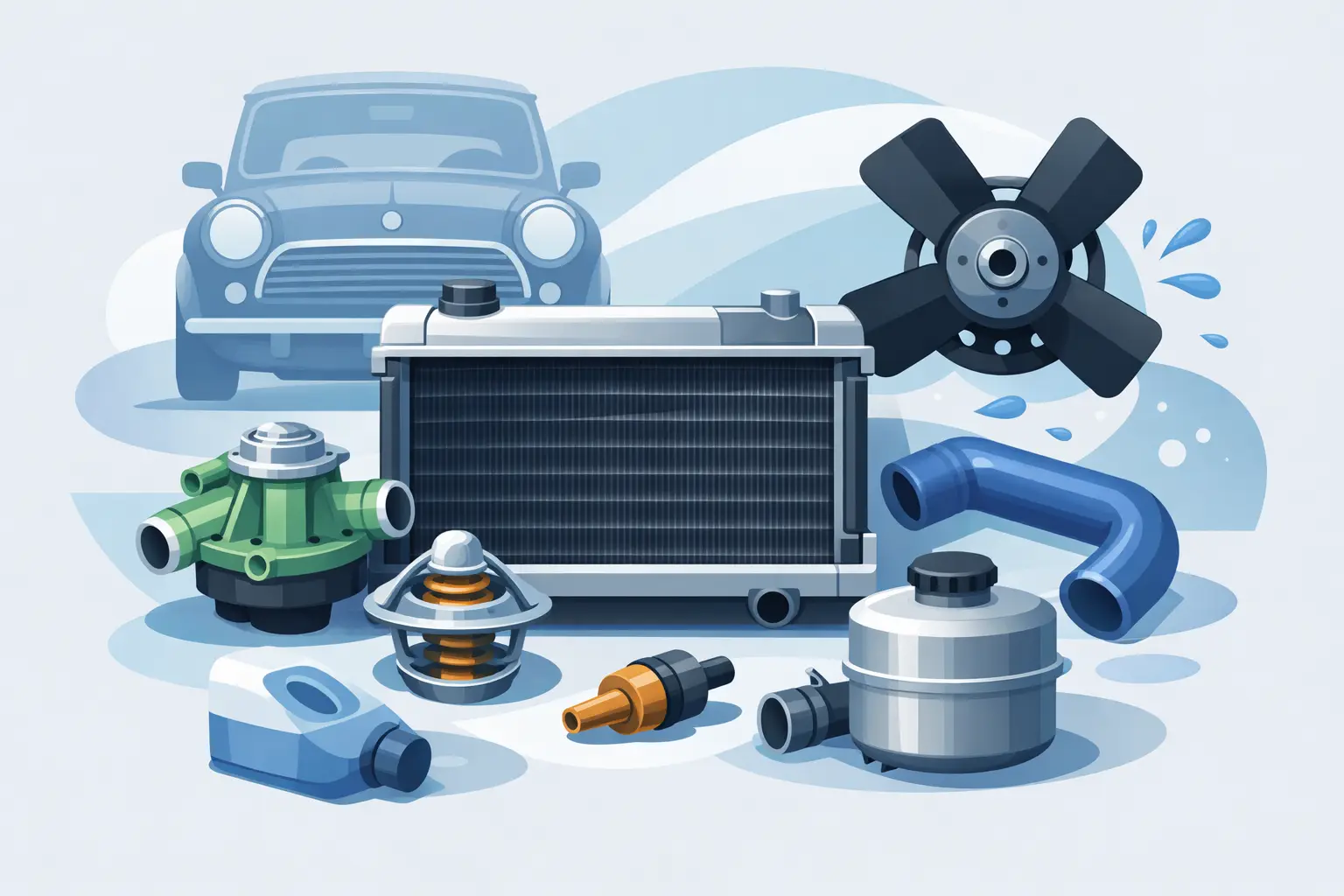
For most owners, the starting point is the radiator, water pump, thermostat, hoses, clips, fan, fan switch where fitted, and the radiator cap. These are the parts that do the real work and the parts that most often age out.
The radiator is the obvious one. Classic Mini radiators can block internally over time, especially on cars that have sat unused or have had poor coolant maintenance. External fins can also corrode or fill with grime, reducing their ability to shed heat. A radiator can still hold water and look serviceable while cooling badly.
The water pump is another common culprit. A worn pump may leak from the seal, make noise from the bearings, or simply move less coolant than it should. If you are already deep into an engine refresh, replacing the pump as preventative maintenance often makes sense. It is a lot easier to do before a failure leaves you stuck.
Thermostats are cheap, but they matter. The correct temperature rating depends on how the car is used, and lower temperature does not always mean better. A thermostat that opens too early can stop the engine reaching proper operating temperature, while one that sticks shut will cause rapid overheating. Quality matters here more than the small saving on a budget part.
Hoses tend to get overlooked because they are not complicated. Even so, old rubber hardens, cracks, or goes soft under heat. A hose can look acceptable from above and still be failing underneath. If the system is apart for other work, fitting fresh hoses and proper clips is usually money well spent.
Why radiators and fans matter more in real traffic
A Classic Mini that behaves on an open road can still struggle in stop-start driving. That usually points towards airflow rather than basic circulation. In slow traffic, the radiator and fan have to work harder because there is less natural air passing through the system.
This is where condition and specification both come into play. A clean, healthy standard setup is often enough for a standard engine used normally. But if the car has been tuned, driven hard, or spends a lot of time in traffic, a tired old radiator and marginal fan setup may no longer be up to the job.
Electric fan conversions can be a worthwhile improvement on some builds, but they are not a magic fix for every overheating complaint. If the radiator core is poor or the system is full of scale, adding a fan only masks the underlying issue. The right order is to make sure the cooling system is healthy first, then consider upgrades if the car’s use demands them.
Choosing classic mini cooling system parts for your type of build
Not every Mini needs the same cooling parts. A largely standard road car has different needs from a fast-road 1275, and both differ from a restoration where originality matters.
For a standard car, reliability and fitment are usually the priority. Good quality replacement hoses, a dependable thermostat, a sound water pump, and a radiator in proper condition will normally keep things under control. There is no point overcomplicating a setup that worked well when new.
For tuned or hard-used cars, cooling capacity becomes more important. Higher compression, spirited driving, summer events, and urban traffic all increase heat load. In those cases, uprated radiators, improved fans, or related supporting parts can be a sensible step. The key is matching the parts to the engine and how the car is actually used, not just buying the most expensive option.
For restorations, appearance may matter as much as performance. Some owners want factory-correct style parts, while others are happy to keep the original look but improve reliability where it cannot be seen easily. There is no single right answer. It depends whether the car is being judged on originality, driven regularly, or expected to do both.
The small parts that cause big headaches
A lot of overheating faults come down to the bits people leave until last. The radiator cap is a good example. If it cannot hold the right pressure, coolant can escape or boil at a lower temperature than intended. It is a small part, but it has a big effect on how the system behaves.
Temperature senders and gauges can also send owners in the wrong direction. Sometimes the engine is genuinely hot. Sometimes the gauge is inaccurate and the cooling system gets blamed unfairly. If the readings look odd, it is worth checking the sender, wiring, and gauge before changing half the system.
Clips, seals, and gaskets matter too. A minor seep may not look serious, but coolant loss over time reduces the system’s margin for error. A Mini that is slightly low on coolant in winter may become an overheating problem in July.
When to replace parts together
There are times when changing a single component is fine, and times when it is false economy. If a hose has split but the rest of the system is fresh, replace the hose and move on. But if the radiator is out, the pump is old, the thermostat housing is off, and the hoses are original-looking, it usually makes sense to refresh the lot.
This approach saves time and avoids chasing faults one by one. It also makes more sense on a car that has been off the road, one undergoing restoration, or one with an unknown maintenance history. Classic Minis are simple cars, but cooling issues can become surprisingly time-consuming when old parts fail in sequence.
Fitment and quality matter on a Mini
Classic Mini owners already know that not all parts are equal. Cooling components are no exception. A poor-fitting hose, a weak cap, or a thermostat with inconsistent opening temperature can turn a straightforward job into repeated strip-downs.
That is why specialist supply matters. Buying classic mini cooling system parts from a supplier who understands the model range makes life easier, especially where engine type, year, and specification affect fitment. Bull Motif Mini Spares is built around that practical reality – getting the right parts for the car in front of you rather than expecting owners to guess.
A sensible way to diagnose before ordering
If your Mini is running hot, start with the symptoms. Does it overheat only in traffic, only on a run, or all the time? Is it losing coolant, pushing coolant out, or simply reading high on the gauge? Does the heater performance change? Is there noise from the pump or obvious staining around joints?
Those details help narrow it down. Traffic-only overheating often points towards airflow or fan issues. Constant overheating can suggest circulation, blockage, or a thermostat fault. Coolant loss brings caps, hoses, clips, and leaks into the frame straight away. The more precise the diagnosis, the easier it is to buy the right parts first time.
A cooling system does not need to be complicated to be dependable. It just needs every part to do its share. If your Mini is due some attention, treat the system as a package, choose parts that suit the car and its use, and you will usually end up with something far more valuable than a lower gauge reading – confidence to use the car properly.