If you are looking at how to upgrade Mini brakes, the first question is not which shiny part to buy first. It is how you actually use the car. A road Mini on 10-inch wheels needs a different approach from a fast-road 1275, and both are different again from a track car that spends its life braking hard into corners.
Get that bit right and the rest becomes much easier. Get it wrong and you can spend good money on a brake setup that feels disappointing, upsets the balance of the car, or simply will not fit behind your wheels.
How to upgrade Mini brakes without wasting money
The best brake upgrades are matched upgrades. Bigger is not always better on a Classic Mini. In many cases, a car with good standard components, quality pads, fresh hoses and correctly adjusted rear brakes will stop better than a poorly planned disc conversion.
Start by being honest about the current setup. If the pedal feels long, the car pulls to one side, or braking fades quickly, you may have a fault rather than an upgrade problem. Worn drums, glazed pads, contaminated linings, old fluid or tired rubber hoses can all make the brakes feel weak. Sorting the basics first gives you a proper baseline.
For a standard or mildly tuned road car, the biggest gains often come from quality friction materials and fresh hydraulic parts rather than extreme hardware. For a more powerful Mini, especially one used enthusiastically on B-roads or in competition, you may well need more disc, more pad, and better heat control.
Start with the condition of the existing system
Before fitting upgraded parts, inspect everything. Check the front discs or drums for wear, the rear wheel cylinders for leaks, the handbrake mechanism for free movement, and the master cylinder for consistent pedal pressure. Look closely at the flexible brake hoses too. Old hoses can swell internally and make the brakes feel vague even if they look acceptable from the outside.
Fluid condition matters more than many owners think. Old brake fluid absorbs moisture over time, which lowers its boiling point and encourages corrosion in the system. If you are upgrading for fast-road or track use, fresh high-quality fluid is a sensible part of the job, not an optional extra.
It is also worth checking wheel and tyre condition. Grip and braking work together. There is not much point fitting a more capable front brake setup if the tyres are hard, old or poorly matched.
Choosing the right front brake upgrade
On most Minis, the front brakes do the real work. That means your front setup is where most of the upgrade thinking should go.
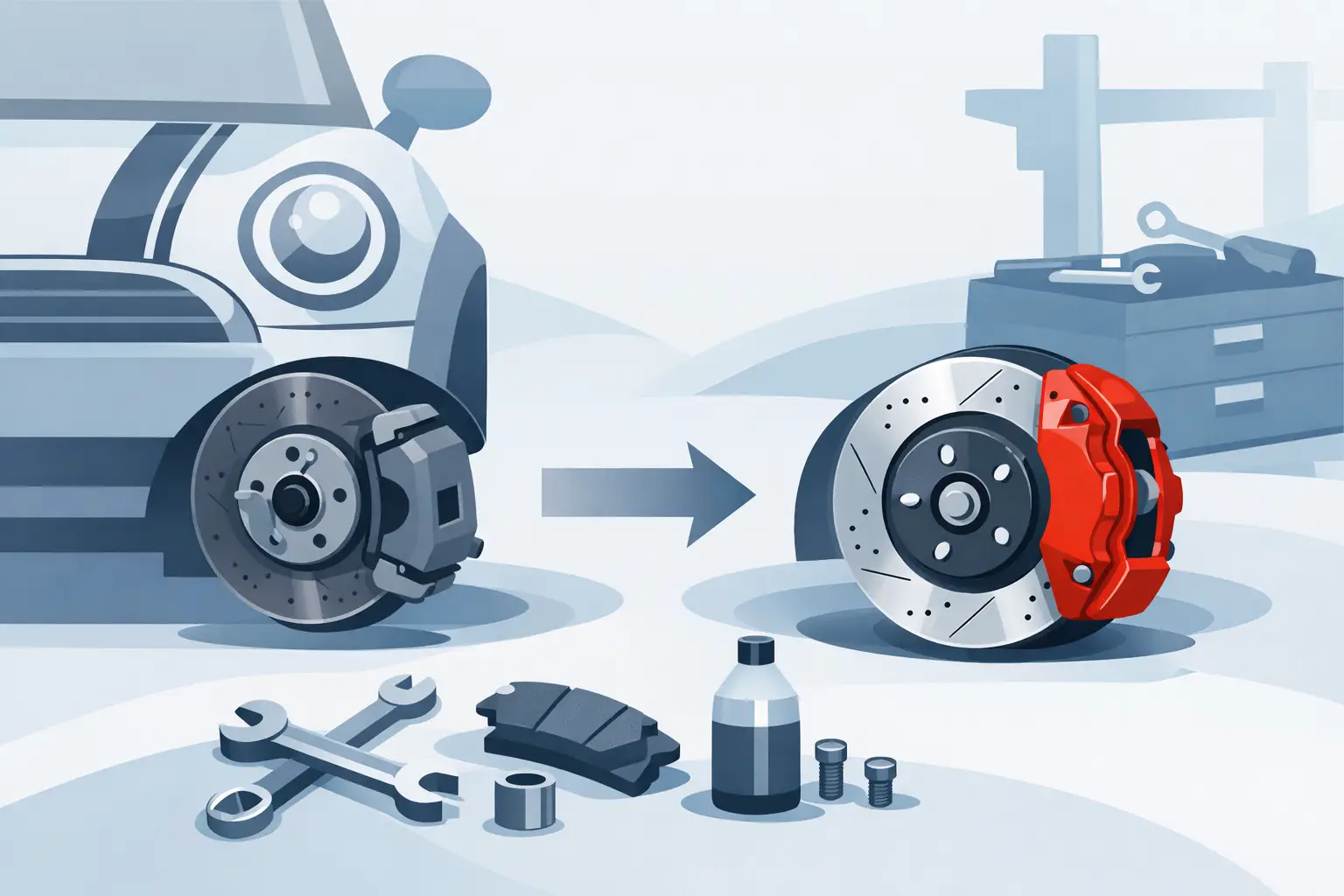
If your car already has front discs, a sensible first step is often to fit good-quality replacement discs and better pads. This keeps the system simple, preserves wheel fitment options, and can transform pedal feel and stopping confidence. A lot of owners are surprised how much improvement comes from decent parts fitted properly.
If the car still runs front drums and you use it regularly on modern roads, a disc conversion is usually the most worthwhile upgrade. It improves consistency, resists fade better, and makes parts choice easier in future. That said, not every conversion suits every wheel. Some larger caliper and disc combinations will not clear 10-inch wheels without very specific components.
For fast-road cars, four-pot caliper kits can make sense, but only when matched to the rest of the car. They can give stronger, more repeatable braking and better heat handling, but they also cost more and may require wheel changes. If you are building a brisk road Mini rather than a competition car, a well-sorted standard disc setup with uprated pads is often the better-value option.
Pads make a bigger difference than many expect
Brake pad choice changes the character of the brakes more than people often realise. Some pads work well from cold and suit everyday road use. Others need heat before they bite properly and are better suited to motorsport. Fit a track-focused pad to a road Mini and you may end up with poorer low-speed stopping, more noise and more dust than you want.
That is why there is no single best answer. For most road cars, choose a quality fast-road pad with good cold bite and predictable feel. For occasional track use, you may accept a little noise or dust in return for better resistance to fade.
Do you need rear brake upgrades?
Usually, not as much as you think. On a Mini, over-braking the rear axle is a quick way to make the car unstable, especially in the wet. Rear drums in good condition are perfectly serviceable on many road and fast-road builds.
That does not mean you ignore the rear. Worn shoes, seized adjusters and leaking cylinders will spoil the whole system. Restoring the rear brakes to proper condition is often enough. On higher-spec builds, rear upgrades can help, but they need to be chosen carefully so the car keeps the right front-to-rear balance.
If you are considering a rear disc conversion, think hard about the real use of the car. They can look appealing and offer easier maintenance in some cases, but they are not automatically the best road choice. For many owners, money is better spent improving the front brakes and refreshing the rear drums properly.
Servos, braided hoses and master cylinders
A brake servo is often misunderstood. It does not increase outright braking power on its own. What it does is reduce pedal effort, which can make the car feel easier and more reassuring to drive, especially in traffic or for owners who prefer a lighter pedal. Some drivers like that. Others prefer the firmer, more direct feel of a non-servo setup.
Braided hoses can sharpen pedal feel by reducing hose expansion under pressure, but only if the rest of the system is in good order. They are not a cure for poor brakes caused by worn parts elsewhere. Fit them as part of a planned refresh, not as a hopeful shortcut.
Master cylinder choice matters too, particularly if you are mixing components from different brake setups. The wrong cylinder can upset pedal travel and feel. On a Classic Mini, compatibility is everything, so it pays to match parts properly rather than assembling a system from whatever happens to be available.
Wheel size and fitment can decide the whole upgrade
This is where many brake plans go off course. Wheel diameter, wheel design and caliper clearance all matter. Some Mini owners want to keep the look and handling of 10-inch wheels, which limits brake options but certainly does not rule out strong braking. Others are happy to move to 12-inch wheels to open up more kit choices.
Neither route is automatically right. Ten-inch wheels preserve the classic stance and steering character many owners want. Twelve-inch wheels can make larger brake packages easier to fit. The key is deciding early, because brake choice and wheel choice often have to be made together.
If you are unsure, buy with fitment in mind, not just headline performance figures. A well-matched setup that fits first time is far better than a theoretically impressive one that creates clearance headaches.
How to upgrade Mini brakes for road, fast road and track
For a standard road Mini, keep it simple. Fresh discs or drums as required, quality pads or shoes, sound cylinders, good hoses and new fluid will usually cover what the car needs. You want confidence, consistency and easy maintenance.
For a fast-road Mini with more power, front discs with uprated pads are the usual starting point, backed up by healthy rear drums and correctly chosen hydraulic parts. If the car is driven hard on demanding roads, better heat resistance becomes more important than outright pedal weight.
For track use, the conversation changes. Heat build-up, repeated heavy braking and pad choice become central. This is where larger disc and caliper options may be justified, along with motorsport-grade pads and fluid. Even then, the best setup depends on car weight, tyre grip, wheel size and how hard the car is being used.
Fit it properly or do not expect proper results
Good brake parts fitted badly will still give poor results. Clean assembly, correct torque settings, proper bleeding and careful bedding-in all matter. Pads and discs need time to mate together. If you fit new parts and immediately abuse them, you can ruin performance before the setup has had a fair chance.
Once the work is done, test the car progressively and pay attention to feel. The pedal should be consistent, the car should brake in a straight line, and the response should suit the way you drive. If something feels off, investigate it early rather than assuming it will sort itself out.
For many Classic Mini owners, the smartest route is not the most extreme brake package. It is choosing quality parts that match the car, the wheels and the way it is used. That is usually where the real upgrade lives, and it is the reason specialists such as Bull Motif Mini Spares remain the sensible place to start when you want parts that actually fit the job.
A Mini that stops cleanly and predictably is simply more enjoyable to drive, whether it is a tidy road car, a quick weekend toy or a full rebuild finally heading back onto the road.