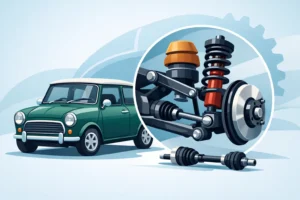
A Classic Mini’s suspension is one of the main reasons it feels unlike any other small car. The rubber cone versus coil springs question is not simply about making the ride softer or lowering the car. It affects how the Mini turns in, how it copes with broken road surfaces, how easily it can be set up, and how close it remains to the original design.
For most road-going Classic Minis, a correctly fitted and properly maintained rubber cone set-up remains hard to beat. Coil springs can suit certain modified cars, but they are not an automatic upgrade. The right choice depends on the condition of the rest of the suspension, how the car is used, and whether originality, adjustability or a particular handling feel matters most.
Why the Mini uses rubber cones
Sir Alec Issigonis’ Mini was designed around compactness. Conventional coil springs would have taken up valuable space in a car with a transverse engine, tiny wheels and very short overhangs. The rubber cone suspension system gave the Mini a compact springing medium while allowing room for the drivetrain and passenger compartment.
A standard dry-suspension Mini uses a rubber cone spring at each corner, working with a trumpet or adjustable strut, knuckle joint, suspension arm and damper. As the cone compresses, its resistance increases. This progressive spring rate is a key part of the Mini’s character: it can move over smaller bumps, then firms up as cornering loads build.
That is why a healthy standard Mini can feel controlled and remarkably capable without using especially stiff dampers. It does not float, but it should not crash over every pothole either. When a Mini feels harsh, low and unsettled, aged rubber cones or worn associated parts are often the real cause.
Rubber cone versus coil springs: the main differences
The greatest difference is how each type of spring reacts through its travel. Rubber cones have a rising rate, becoming firmer the further they are compressed. Most coil springs are designed with a more predictable rate, although progressive-rate coils are also available. This makes a coil conversion easier to tune around a specific use, but only when the complete kit and damper specification are correctly matched.
Rubber cones are also extremely compact. They suit the original Mini suspension layout and preserve the clearances that the car was engineered around. Replacing them with coils requires conversion components designed to locate the spring safely and keep the suspension operating within sensible geometry.
Ride quality is more complicated than the material of the spring. Fresh rubber cones can initially feel firmer than tired old units, particularly before they have settled. Yet a Mini on collapsed cones can be both harder-riding and less controlled because it has lost usable suspension travel. Coil springs may offer a more conventional feel, but an overly stiff spring rate or poorly matched dampers can make a converted Mini unpleasant on ordinary roads.
Rubber cone benefits
For a standard restoration, regular road car or period-correct build, rubber cones are usually the sensible choice. They retain the intended handling balance and work with the standard suspension architecture. Quality replacement cones, fresh knuckle joints and sound trumpets or adjustable struts can transform a Mini that has gradually deteriorated over years of use.
They are particularly well suited to owners who want a car that feels like a Mini rather than a generic small classic. Turn-in remains sharp, body movement stays well controlled, and the progressive action offers useful resistance when the car is loaded or driven enthusiastically.
Rubber cones do age. They can harden, settle and eventually collapse, reducing ride height. A Mini sitting unusually low is not automatically “nicely lowered”; it may simply need suspension attention. Replacing cones is more involved than changing a conventional coil spring and requires the correct cone compressor, but it is a proper repair rather than a compromise.
Coil spring benefits
A well-engineered coil spring conversion can appeal to a modified, competition-focused or highly adjustable build. Coils can make spring-rate selection more straightforward for a car with major changes such as a different engine, track-biased tyres, altered weight distribution or dedicated circuit use.
Some conversion systems also make ride-height adjustments simpler. That can be useful where a car has been built around particular wheel and tyre sizes, or where corner weights and suspension settings are being refined. However, ride height should never be set by appearance alone. A very low Mini may look purposeful but can run out of bump travel, damage tyres on arches and put suspension arms in poor operating angles.
The best coil conversions are complete systems, not a collection of improvised parts. Spring location, upper and lower mounts, damper travel, clearance to the subframe and geometry throughout suspension movement all need to be considered together.
What changes when fitting coil springs?
A coil conversion is not normally a direct replacement for a rubber cone. The standard cone, trumpet or strut arrangement is built around the original load path. A conversion kit must provide secure spring seats and retain the spring through full droop and compression, while allowing the suspension arms to move freely.
This is where a cheap or poorly specified conversion can create trouble. If a spring is not properly located, if the dampers bottom out before the suspension reaches its bump stops, or if the spring rate is far too high, the result can be unpredictable rather than sporty. Front and rear rates also need to work together. Stiffening one end disproportionately can alter understeer and oversteer behaviour in a car with a very short wheelbase.
Dampers matter just as much. They do not hold the car up, but they control the speed of suspension movement. Fresh standard-style dampers may suit a standard rubber-cone Mini, while uprated adjustable dampers can be useful on a modified car. The damper must have suitable travel for the chosen ride height and spring arrangement. A lowered car on incorrect dampers will not be cured by simply winding the settings harder.
It is also wise to inspect the rest of the suspension before making a decision. Worn lower arm bushes, tie-rod bushes, ball joints, wheel bearings, rear radius arm bearings and knuckle joints can all make a Mini wander, knock or ride badly. Springs cannot compensate for movement in tired components.
Which set-up suits your Mini?
If you are restoring a Mk1, Mk2, Mk3 or later Classic Mini for road use, rubber cones are generally the right answer. They are faithful to the design, proven over decades and readily supported by the standard parts layout. Pair them with good dampers, sound bushes and sensible wheel alignment, and the car should feel eager rather than punishing.
For a fast-road Mini, rubber cones still deserve serious consideration. Adjustable struts can give practical ride-height control without abandoning the original springing system. A carefully chosen damper and tyre combination often brings more worthwhile improvement than changing to coils.
Coil springs make more sense where the Mini is already substantially modified and its suspension is being developed as a system. A track car, hillclimb car or bespoke project may benefit from the ability to select rates precisely. Even then, choose a kit with a clear application, fit it carefully and expect to spend time setting alignment, damper adjustment and ride height.
There is also a middle ground worth remembering. Not every hard-riding Mini needs a conversion, and not every low Mini needs to stay low. New quality rubber cones, adjustable suspension components where appropriate, and a full check of the front and rear suspension can restore a far more usable car than changing one component in isolation.
Before ordering suspension parts
First, identify what is already fitted. Many Minis have been altered over the years, and the parts on the car may not match its original specification. Check whether it has dry rubber-cone suspension or an earlier Hydrolastic arrangement, as these are entirely different systems. Measure ride height on level ground and look for obvious cone collapse, leaking dampers, split bushes and excessive play at the arms or joints.
Next, be honest about how the car is used. A weekend road Mini needs compliance on uneven B-roads. A show car may prioritise stance and originality. A competition car may need a set-up chosen around rules, tyres and surface type. Those are different jobs, so they should not receive the same suspension answer.
For owners rebuilding a standard or fast-road Mini, Bull Motif Mini Spares can help source the core suspension parts needed to do the job properly, rather than replacing only the most visible item. Fresh cones, knuckle joints, bushes, dampers and the correct fitting hardware give the new parts the chance to work as intended.
A Mini suspension rebuild rewards patience. Set the car at a sensible height, allow new components to settle, then check wheel alignment before judging the finished result. Whether you retain rubber cones or build around coils, the best set-up is the one that gives your Mini usable travel, predictable handling and confidence on the roads you actually drive.