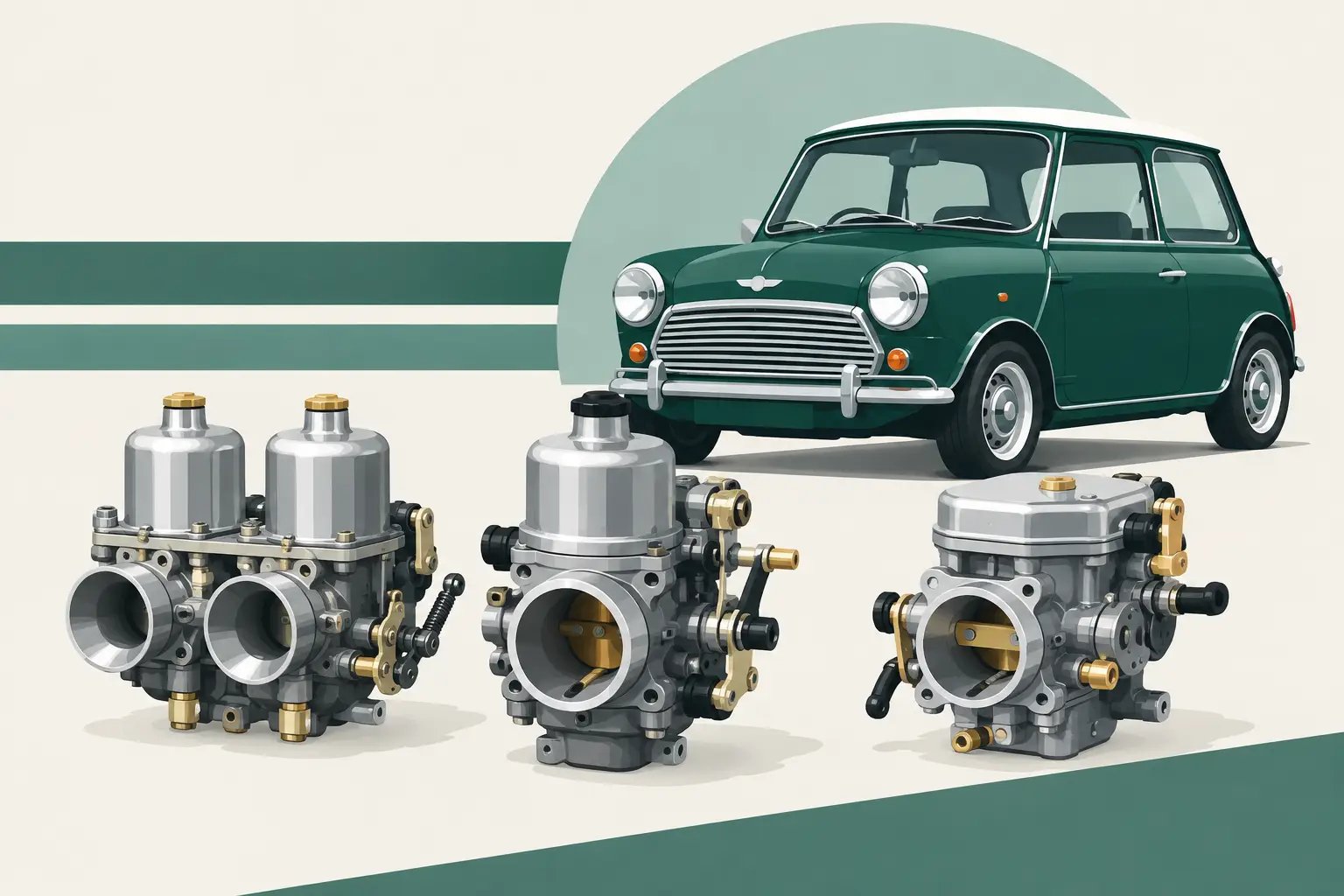
A carburettor change can make a Classic Mini feel properly lively, or leave it flat, thirsty and awkward in traffic. With A-series carburettors compared side by side, the best choice is rarely the largest one. Engine capacity, cylinder head, camshaft, exhaust and how the car is actually driven all matter more than pub-talk peak horsepower figures.
For most road Minis, a correctly specified and tuned SU gives the best blend of response, economy and reliable everyday use. Twin-carb and Weber installations have their place, especially on modified 1275 engines, but they need the rest of the engine to support them.
A-series carburettors compared: start with the engine
The A-series responds well to sensible improvements, but it is easy to fit a carburettor that is too large for the engine’s airflow needs. A big choke or large bore can reduce air speed at low revs, weakening throttle response and making the car less pleasant when pulling away or climbing hills.
A standard 998, for example, does not usually benefit from a large performance carburettor. It needs a stable mixture and good low-speed torque. A healthy 1275 with a freer-flowing exhaust, suitable inlet manifold and modest road cam can use more airflow and may respond very well to a larger SU or twin-carb arrangement.
Before choosing a carburettor, be honest about the build. Consider the engine size, head specification, camshaft, inlet manifold, exhaust system and intended use. A touring Mini, a quick road car and a competition car can all use different carburettors successfully, even with similar capacity engines.
Single SU carburettors
The SU is the familiar choice for Classic Mini owners, and for good reason. Its variable venturi design meters air and fuel progressively rather than relying on fixed choke sizes. In practical terms, it gives smooth part-throttle running and good flexibility across the rev range when fitted with the correct needle, spring and dashpot oil.
SU HS2
The HS2 has a 1.25-inch bore and was fitted to many smaller-capacity A-series engines. It is a strong choice for a standard or mildly improved 848cc, 998cc or 1098cc unit where drivability matters more than outright power.
On a standard 998, the HS2 provides crisp low-speed manners and can return respectable fuel economy. It is also compact and suits original-style installations. A pair of HS2s was used on some performance Mini applications, giving more total airflow while retaining good air speed through each carburettor.
A single HS2 can become restrictive on a modified 1275, or on an engine expected to spend plenty of time at higher revs. That does not make it a bad carburettor – it simply means it is working beyond the role it was designed for.
SU HS4
At 1.5 inches, the HS4 is a popular step up for road-going A-series engines. It is commonly used on 1098 and 1275 applications and is often a sensible upgrade for a mildly tuned 998, provided the rest of the inlet setup is suitable.
An HS4 can give a useful increase in airflow without sacrificing the friendly road manners that make an SU so effective in a Mini. For many fast-road 1275 builds, it is enough carburettor when paired with a decent manifold, appropriate needle and a properly set ignition system.
The separate float chamber is familiar and straightforward to service, although it needs to be positioned correctly and its fuel feed, float height and linkage must all be in good order. Wear in the throttle spindle or carburettor body can cause air leaks and inconsistent idle, so rebuilding a tired original unit is often worthwhile before chasing other faults.
SU HIF38 and HIF44
The HIF range uses an integral float chamber beneath the carburettor body. This creates a neater installation and was used on later A-series applications. The HIF38 is broadly comparable in bore size to the HS4, while the HIF44 has a larger 1.75-inch bore and is a well-known choice for stronger 1275 engines.
For a mildly modified 1275 road Mini, the HIF44 is often one of the best all-round options. It has enough airflow for a good cylinder head, exhaust and road cam, yet can remain civilised in town when the needle and ignition timing are right. Many owners choose it because it supports future upgrades without immediately forcing a move to twin carburettors or a Weber.
That said, an HIF44 is not automatically better than an HS4. On a near-standard small-bore engine it can be excessive, and no carburettor will compensate for low compression, a worn distributor, blocked fuel filter or poorly adjusted valves. The larger carburettor also needs a matching manifold and a suitable air filter arrangement, with clearance checked carefully around the bulkhead and brake servo where fitted.
Twin SU carburettors
Twin SUs look right under the bonnet of a performance Classic Mini and can work extremely well. Twin HS2s are a traditional setup for 998 and 1275 performance engines, while twin HS4s provide greater airflow for more serious 1275 builds.
The advantage is not simply that there are two carburettors. Each cylinder pair has a shorter, more direct inlet path, and the engine can receive the airflow it needs at higher revs without relying on one very large carburettor. On a properly built engine, the result can be strong mid-range pull and an eager top end.
The compromise is adjustment. Both carburettors must be in good condition and balanced correctly. Throttle spindles, jets, needles, linkages and piston movement all need attention. If one carburettor is doing more work than the other, the engine may idle unevenly, hesitate on progression or run poorly under load.
Twin carbs are best suited to an engine built around them. A decent head, camshaft, exhaust and ignition setup allow the installation to earn its keep. Fitting twins to a standard engine may improve the under-bonnet appearance more than the driving experience, while adding extra fuel use and servicing time.
Weber DCOE carburettors
The Weber DCOE is the traditional performance option for an A-series, particularly in motorsport and high-output fast-road builds. Its separate chokes, jets and progression circuits allow very precise setup by someone who understands the carburettor and the engine combination.
A correctly jetted Weber can deliver sharp response and excellent high-rev performance. It is a sensible consideration for a well-developed 1275 or larger A-series engine with a flowed head, suitable cam and exhaust. For competition use, where the engine spends more time at wide-open throttle and high revs, its strengths are clear.
For an everyday road Mini, however, a Weber can be more demanding than an SU. Initial cost, manifold choice, air filtration, fuel consumption and professional jetting all need to be allowed for. Cold running and low-speed progression can be less forgiving if the setup is not right. Clearance can also be an issue, depending on the manifold and body arrangement.
A Weber is not a shortcut to a fast Mini. It is a specialist component that rewards a matched engine build and careful tuning.
Choosing the right setup for your Mini
As a practical guide, a standard 998 is usually happiest with its correct single HS2 or a well-matched alternative SU setup. A lightly modified 998 may suit an HS4, but only if the breathing upgrades justify it. A standard or mildly tuned 1275 generally works very well with an HS4, HIF38 or HIF44 depending on the specification and intended use.
For a stronger fast-road 1275, the HIF44 is often the sensible single-carb choice. It gives useful headroom while preserving the simple, usable character that makes a road Mini enjoyable. Twin HS2s or HS4s become attractive when the engine has the head, cam and exhaust to benefit, while a Weber DCOE is generally for more focused performance or competition builds.
Whatever you fit, allow for the complete installation rather than buying the carburettor alone. You may need the correct inlet manifold, gaskets, studs, throttle cable or linkage parts, fuel hose, filter, heat shield, air filter and breather connections. A suitable needle is essential, and final tuning should include ignition timing, mixture, idle speed and a road test under load.
Do not overlook condition and tuning
A worn SU will not perform like a rebuilt one. Check for spindle wear, fuel leaks, sticking pistons, damaged diaphragms where applicable, tired needles and jets, and float problems. On twin setups, synchronisation is as important as mixture adjustment.
It is also worth checking the basics before blaming the carburettor. Correct valve clearances, compression, plugs, leads, distributor condition and fuel supply all affect how the Mini runs. Carburettor tuning is part of the job, not the whole job.
Bull Motif Mini Spares can help owners source the carburettor parts, manifolds, gaskets, filters and service items needed to keep an A-series installation dependable. Choose the setup that matches the engine you have now, then tune it carefully – a Mini that pulls cleanly from low revs is usually more rewarding on the road than one built around the biggest carburettor available.