A Classic Mini with the wrong exhaust never feels quite right. Sometimes it drones on the motorway, sometimes it sits badly under the car, and sometimes it simply refuses to line up with the manifold without a fight. That is why choosing classic mini exhaust parts properly matters – not just for noise or looks, but for fitment, reliability and how the car drives every time you turn the key.
Why classic mini exhaust parts matter more than people think
On paper, an exhaust system looks simple enough. In practice, it is one of those areas where small differences make a big impact. Bore size, manifold type, hanger position, mounting rubbers and even the way the system routes under the floor all affect how well it works on a Mini.
A standard road car needs something very different from a fast-road 1275 or a track-biased build. Go too restrictive and you leave performance on the table. Go too large and you can lose drivability lower down the rev range, not to mention gain a noise level that gets tiresome quickly. A good system suits the engine spec, the way the car is used and the owner’s expectations.
That is also why buying from a specialist makes sense. Minis are not modern hatchbacks with one broad-fit solution. Year, engine, subframe arrangement and existing modifications all play a part.
The main classic mini exhaust parts in a typical system
Most owners start by thinking about the rear box, but the whole system needs to be considered together. The manifold is where exhaust gases leave the engine, and its design affects flow from the start. Standard cast manifolds are fine on many road cars, while LCB and other performance styles are often chosen for tuned engines.
From there, the downpipe and centre section carry gases through the system. Bore size matters here. A small-bore setup generally suits standard or lightly tuned cars, while larger bores are usually chosen for engines with supporting modifications such as improved cylinder heads, camshafts or carburation.
At the back, the silencer or rear box shapes the final sound and back pressure characteristics. Twin-box systems usually keep things quieter and more civilised for regular road use. Single-box and RC40-style setups are popular because they offer a good balance of performance and tone, but not every version sounds the same.
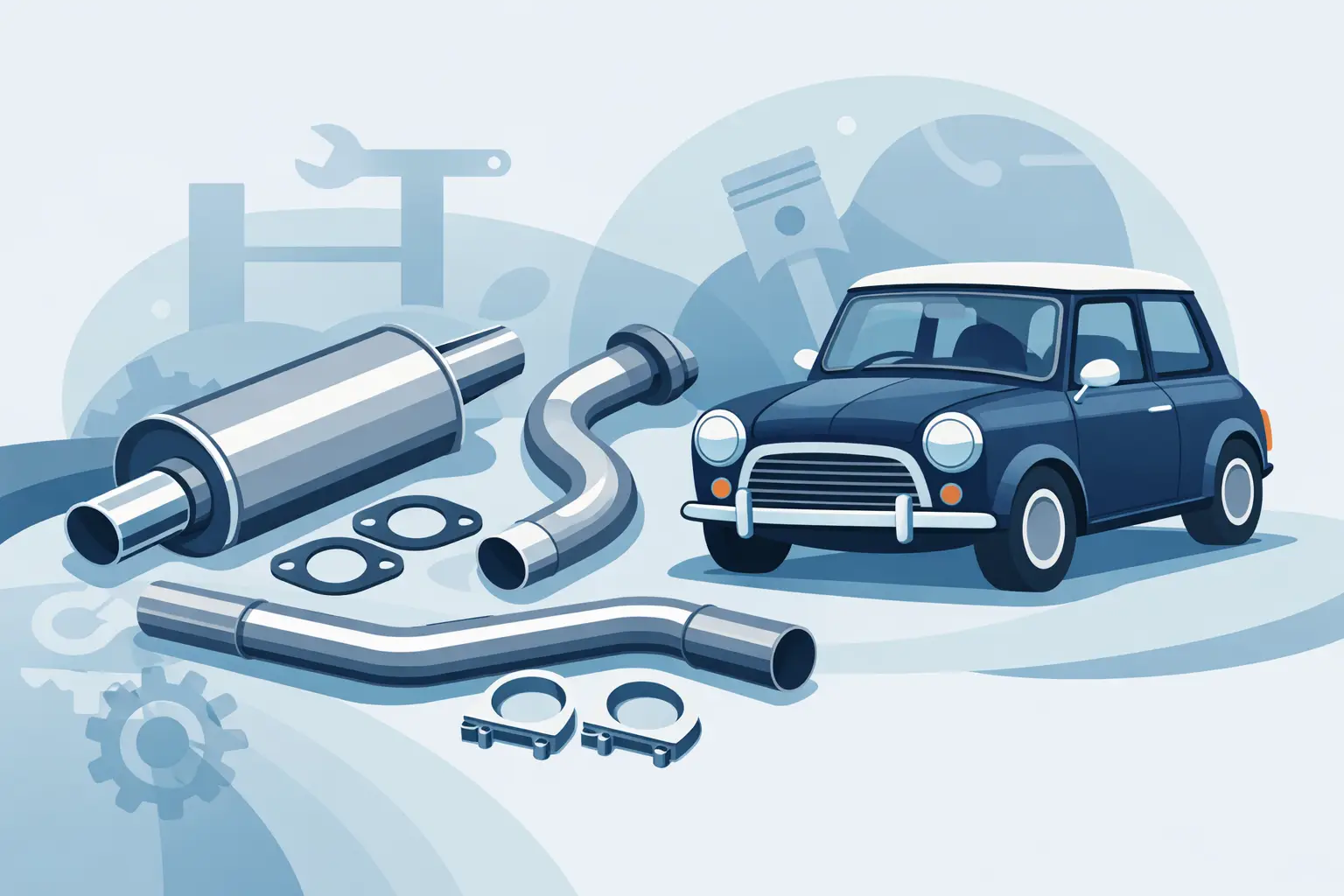
Then there are the parts people often forget until fitting day – clamps, mounts, exhaust rubbers, manifold fittings, sealing rings, hangers and brackets. These small items can be the difference between a tidy install and a system that knocks, leaks or sits crooked.
How to match the exhaust to the car
The biggest mistake is choosing on appearance alone. A big-bore polished system may look the part, but that does not automatically make it the best option for a mostly standard 998 used for weekend runs and local shows.
For a standard or near-standard road Mini, a well-made small-bore system often gives the best result. It keeps exhaust-gas speed up, tends to be easier to package and usually avoids the flat feeling that can come from oversizing. Noise is often more manageable too, which matters if the car sees regular use.
For a mildly tuned engine, the choice becomes more open. A free-flow manifold paired with a suitable performance exhaust can sharpen throttle response and help the engine breathe better through the mid-range. This is where it pays to be realistic about the rest of the setup. If the cylinder head, carb and ignition are still standard, a very aggressive exhaust may not deliver the gains some owners expect.
For highly tuned or competition builds, the exhaust needs to support the engine rather than limit it. At that point, bore size, collector design and system routing become more critical, and compromises on refinement are more acceptable. A road-going restoration and a sprint or hillclimb Mini simply do not need the same thing.
Sound, fit and ground clearance
Ask any experienced Mini owner what matters after performance, and the answer is usually fit. A system that looks great in a catalogue but sits too low under the car will quickly become annoying. Speed bumps, uneven roads and steep driveways soon expose poor clearance.
Sound is equally personal. Some owners want the crisp, period-correct note of a subtle road system. Others want more bark without unbearable cabin boom. The trouble is that “sporty” means different things to different people. A setup that sounds brilliant on a short blast can become hard work on a longer journey.
This is where honest expectations matter. A single-box performance system will generally be louder than a twin-box road system. A larger bore often changes the tone as well as the volume. Side-exit arrangements can suit some builds, but they also alter the driving experience, especially on a small car where sound is never far away.
Choosing between standard and performance options
There is no single right answer here. If originality is the priority, standard-style classic mini exhaust parts are usually the sensible route. They preserve the character of the car, fit the purpose of a faithful restoration and avoid turning a calm road Mini into something harsher than intended.
If the car is already upgraded, a performance system can be well worth fitting. The key is choosing a setup that complements the specification instead of overpowering it. A popular road car recipe often combines a decent manifold, sensible bore size and a rear box that improves flow without making every journey feel like a race stage.
Price comes into it as well. A cheaper exhaust can be tempting, but poor fitment and short life often wipe out the saving. Better materials, cleaner welds and properly made brackets usually pay off over time. Stainless systems appeal for longevity, while mild steel still has its place for owners focused on authenticity, budget or period feel.
Fitting classic mini exhaust parts without creating extra problems
Even the right parts can be frustrating if fitted badly. Alignment should never be forced. If the manifold, centre section and rear box are all under tension, the system will often crack, blow or work loose later.
It helps to assemble everything loosely first, check the route under the car, make sure the system clears the subframe and floor, then tighten progressively. New mounts and rubbers are worth fitting at the same time if the old ones are tired. Reusing worn hangers to support a fresh system is a false economy.
Pay attention to the manifold joint as well. Exhaust leaks near the front of the car are common when sealing faces are poor or fittings are overtightened unevenly. If the engine mounts are tired, the engine’s movement can also affect exhaust position and knock the system out of line.
Heat is another thing to watch. A manifold too close to other components can cause problems over time, especially in an engine bay as tightly packaged as a Mini’s. Clearance is not just about avoiding rattles – it is about protecting surrounding parts too.
When it is worth replacing more than one section
Owners often start with a failed rear box and hope to keep the rest. Sometimes that works. Sometimes it becomes obvious that the centre section is thin, the manifold fixings are tired and the mounts have seen better days.
If one part has failed because of age and corrosion, the rest of the system may not be far behind. Replacing matched sections together can save time and repeat labour. It also improves the chance of everything lining up as intended, especially where older parts have been bent slightly over years of use.
That is one advantage of buying from a Mini specialist such as Bull Motif Mini Spares. You are not just looking at a generic exhaust shelf. You are looking at a proper selection of parts grouped around what Mini owners actually need to complete the job properly.
What to check before ordering
Before buying, confirm the engine size, manifold type and whether the car is standard, modified or running a mix of both. Check if you need a complete system or only certain sections. It is also worth confirming whether the car uses standard mounting points and whether there are existing modifications underneath that could affect routing.
If your aim is better road manners, do not chase the biggest or loudest option. If your aim is genuine performance, make sure the rest of the engine can use it. And if your aim is restoration accuracy, focus on quality and correct fit rather than novelty.
A Mini exhaust should do more than make noise. It should fit properly, last well and suit the car you have actually built, not the one you might build later. Get that right, and every drive feels more sorted from the first blip of the throttle to the moment you switch off.