A Classic Mini exhaust is never just an exhaust. It affects the way the car sounds at idle, how civilised it feels on a long run, ground clearance, and sometimes the character of the engine itself. The single box vs twin box exhaust choice comes up regularly when replacing a tired original system or planning an engine upgrade, and the right answer depends far more on how you use your Mini than on which option looks sportier.
A single-box system can suit a lively weekend car brilliantly. A twin-box setup is often the better call for a Mini that sees regular road miles, passengers, or motorway work. Before choosing, it helps to understand what each silencer is doing and where the real compromises sit.
What single-box and twin-box exhausts mean
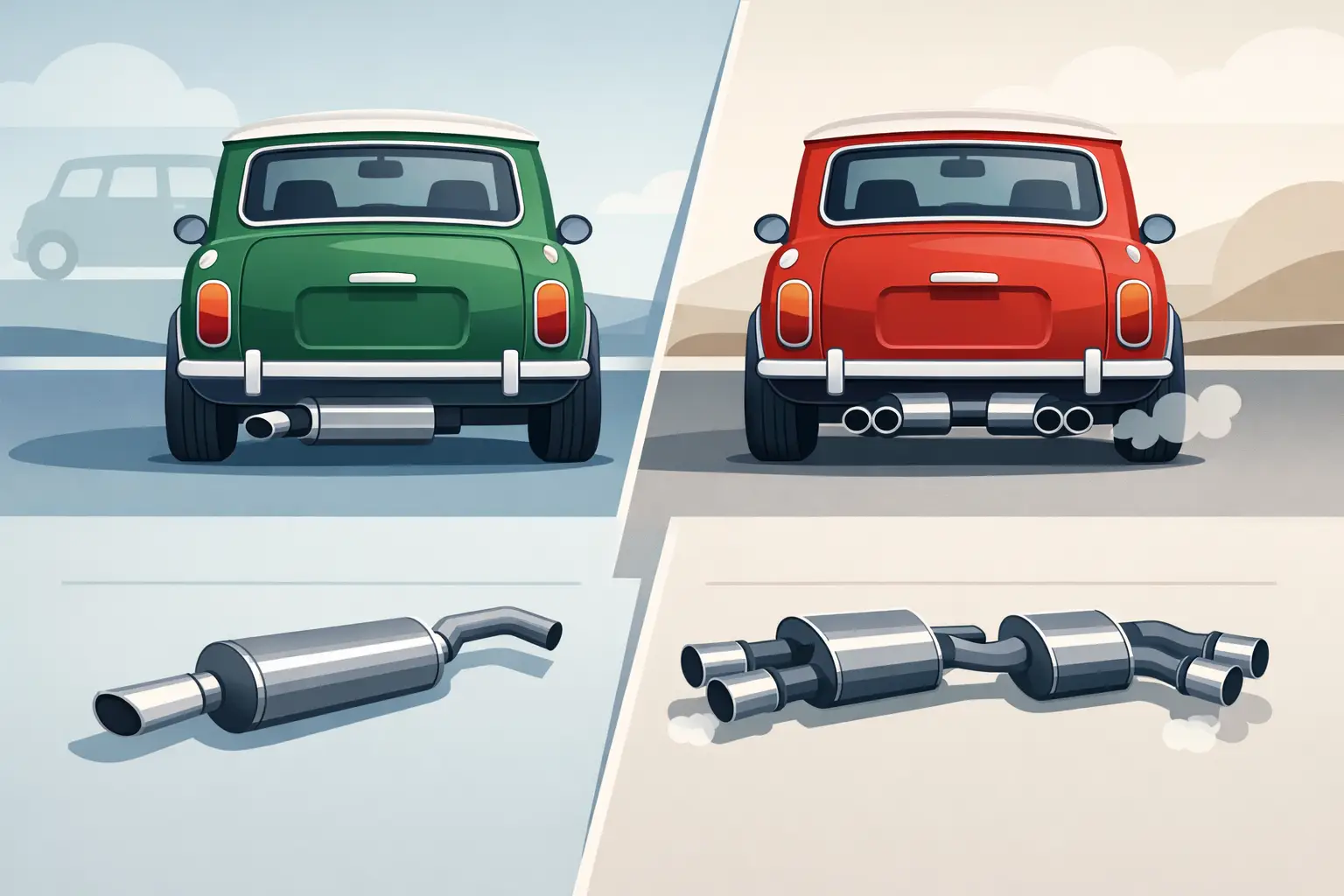
The boxes are silencers. Their job is to reduce the pressure pulses and noise created as exhaust gases leave the engine. On a typical Classic Mini system, a twin-box exhaust uses a centre silencer and a rear silencer. A single-box system removes one of those silencers, usually leaving a rear box, although layouts vary between systems.
Less silencing generally means a freer and louder exhaust note. That does not automatically mean a major power gain. The manifold, downpipe, pipe diameter, engine specification and carburettor or injection setup all matter more than the number of boxes alone.
When comparing systems, make sure you are looking at like-for-like parts. A large-bore performance system with one silencer is not directly comparable with a standard-bore twin-box replacement. Check the pipe size, manifold compatibility, tailpipe arrangement and the shell your Mini is based on before ordering.
Single box vs twin box exhaust: the practical differences
Noise and driving comfort
This is the biggest difference most owners will notice immediately. A single-box exhaust gives the Mini a more present, sharper note. At low speeds it can sound purposeful without being overwhelming, especially on a standard 998cc or mild 1275cc engine. Under acceleration, however, it will be noticeably louder from inside and outside the car.
That can be exactly what you want from a weekend Mini, a club car or a machine built around a modified engine. The downside is drone. At certain engine speeds, particularly when cruising in top gear, a single-box setup can create a constant booming note through the cabin. Minis have little sound insulation compared with modern cars, so the effect can be more tiring than expected on a longer journey.
A twin-box exhaust takes the edge off those frequencies. You still hear the engine and retain the traditional Mini character, but the car is easier to live with on regular runs. If you take the family out, attend distant shows or use the Mini for commuting, the extra silencing is usually worth having.
The exact sound also depends on the exhaust design. Two systems with the same number of boxes can sound very different because of their bore size, internal silencer construction, tailpipe and engine tune. Avoid choosing on the basis of a short video alone. Recordings often fail to show how an exhaust sounds from the driver’s seat at 60 mph.
Performance and engine specification
A common assumption is that a single-box system must make more power because it is less restrictive. Sometimes it can help, but the gain on a standard road engine may be modest. An exhaust needs to flow properly, but it also needs to suit the engine’s capacity, camshaft, cylinder head, induction and intended rev range.
On a fairly standard Mini, a correctly sized twin-box system will not necessarily hold the engine back. It may provide the better all-round result, with useful low- and mid-range response and a quieter cabin. Fitting a very large, very open system to a standard engine can make more noise without delivering the improvement you expected.
A single-box system becomes more attractive as the engine specification rises. A modified 1275cc engine, a free-flow manifold, a larger-bore downpipe and improved induction can benefit from an exhaust designed to match. Even then, the system should be selected as a package, not as an isolated performance part.
For competition use, sound limits set by the organiser or circuit can be decisive. A single box may not pass a test where a twin-box version of the same system will. Check the event regulations before buying parts or booking a track day.
Ground clearance and fitment
Classic Minis sit low, and many are lower still after suspension work. Exhaust clearance matters. Speed humps, uneven B-roads and steep driveways can quickly damage a poorly positioned system, particularly around the rear subframe and centre section.
A single-box layout has fewer components and joints, which can simplify fitting. It can also offer a little more room in the centre of the car, depending on the system. That said, a badly hung single-box exhaust can still knock against the body or subframe, and a large rear silencer can sit vulnerable beneath the valance.
Twin-box systems have more length, more brackets and another component to align, so take extra care during installation. Use the correct mounts, clamps and hanging straps, and do not tighten every joint fully until the whole system is in position. Once fitted, check clearance around the gear change area, rear subframe, suspension components and bodywork. Start the engine and listen for rattles as it settles on its mounts.
Fitment is particularly important on modified cars. An LCB manifold, a different rear subframe, lowered suspension, a larger fuel tank, non-standard wheels or a rear anti-roll bar can all affect the space available. A system that fits one Mini perfectly may need adjustment on another.
Weight, cost and maintenance
A single-box exhaust has fewer parts, so it is often lighter and may cost less than an equivalent twin-box arrangement. It also has fewer joints that can corrode or work loose. For a simple road build, those are worthwhile advantages.
The twin-box option adds another silencer and usually more fitting hardware, but the extra cost buys refinement rather than outright speed. For an owner restoring a Mini to enjoy rather than merely display, that can be money well spent.
Whichever style you choose, quality matters. Thin mild-steel systems can sound acceptable when new but may corrode quickly if the car is used through wet winters or stored without being fully dried out. Stainless steel costs more initially but is a sensible consideration for a car that is kept long term. It may also produce a slightly different note, so do not assume that stainless and mild steel versions will sound identical.
Which exhaust suits your Classic Mini?
Choose a single-box exhaust if your priority is a sportier sound, simpler layout and a slightly more focused feel. It makes most sense for a weekend car, a lightly modified Mini or a build where the engine and induction changes are intended to be heard. Be realistic about how much motorway or long-distance driving the car will do.
Choose a twin-box exhaust if you want the Mini to remain enjoyable over distance. It is usually the sensible option for standard or mildly tuned road cars, daily drivers, family use and restoration projects where the aim is a close-to-original driving experience with dependable replacement parts.
There is also a middle ground. Some performance twin-box systems flow very well while keeping the noise under control. They can be an excellent fit for a fast-road 1275cc Mini that needs to feel eager without becoming wearing. Likewise, a well-designed single-box system can be less intrusive than a poorly made twin-box exhaust.
Do not overlook road legality and the MOT
Your exhaust must be secure, free from significant leaks and not excessively noisy. At MOT time, the tester will assess the system’s condition and whether its noise is clearly louder than a standard exhaust in a way that is likely to be considered unreasonable. A system that attracts unwanted attention on the road can also make everyday ownership less enjoyable.
This is another reason to match the exhaust to the car. A loud system may suit a showground or a short Sunday blast, but the quieter option often proves the better investment once the novelty has worn off. Keep all joints properly clamped, replace perished rubber mounts promptly and investigate rattles early. A loose bracket can turn even a good exhaust into an irritating one.
Build the system around the way you drive
The best choice is not automatically the loudest, cheapest or largest-bore option. Start with your engine specification, then think honestly about where the Mini goes and who travels in it. If the car spends its life on short, spirited runs, a single box may give it exactly the voice you want. If it will cover miles in all weathers, a twin-box system is likely to make every journey more pleasant.
For help matching an exhaust to a standard restoration, a fast-road build or a more serious performance setup, Bull Motif Mini Spares can help you source the right components rather than leaving you to make a compromise after the system is fitted.