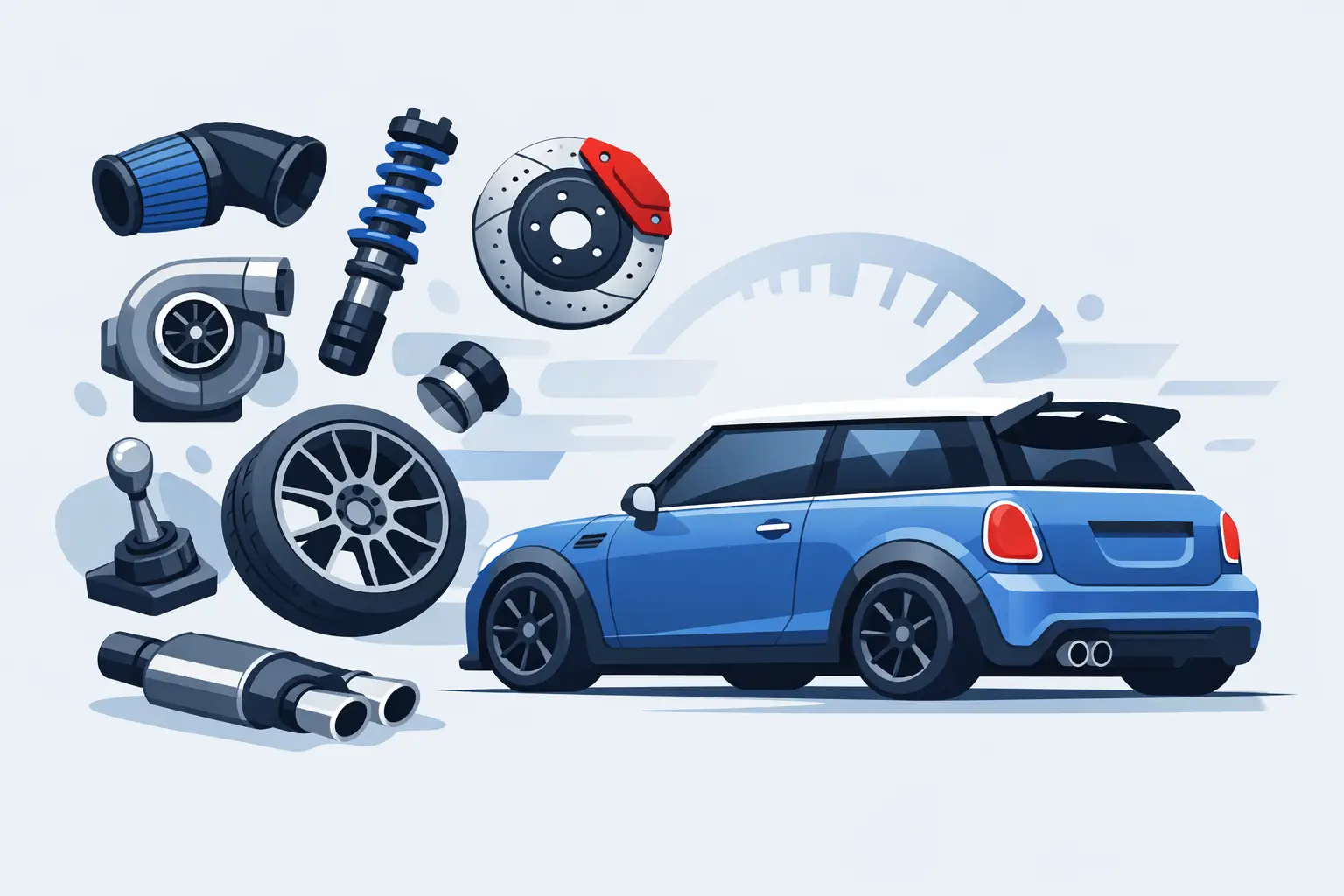
A Classic Mini with the wrong upgrades can feel worse, not better. We speak to plenty of owners who have fitted shiny bits in the hope of instant gains, only to end up with a car that is noisier, fussier, or harder to use on the road. Good mini performance parts should make the car sharper, stronger and more enjoyable without creating problems elsewhere.
That is the key point with performance upgrades on a Mini. These cars respond brilliantly to well-chosen parts, but they also punish mismatched combinations. A fast-road Mini wants a different setup from a weekend cruiser, and a sprint or hillclimb build is different again. If you start with how the car is actually used, the right choices become much clearer.
Choosing mini performance parts with a plan
The best approach is to think in systems rather than individual products. Engine, ignition, fuelling, exhaust, cooling, braking and suspension all work together. Add power without sorting the brakes and you have only moved the weak point. Fit a wild cam without considering carburation and compression, and the result may be disappointing.
For most owners, there are three sensible routes. The first is a mild road build focused on response, reliability and drivability. The second is a fast-road setup with stronger mid-range and better chassis control. The third is a competition-led build where outright performance matters more than refinement. None is automatically better. It depends on whether your Mini spends its time on B-roads, at shows, in town traffic or on circuit.
Budget matters as well. A properly chosen set of entry-level upgrades often gives a better result than spending heavily in one area and ignoring the rest. If you have a limited budget, spread it across the car where it makes the biggest difference.
Start with the engine breathing
If you want noticeable gains without turning the car inside out, start by improving how the engine breathes. On a Classic Mini, that usually means the inlet, exhaust and cylinder head are the first places to look.
A better air filter and a freer-flowing exhaust can wake the car up, particularly on smaller-bore engines that still have restrictive original parts fitted. That said, not every loud exhaust is a good exhaust. Some systems suit road cars with decent low-down torque, while others push the power higher up the rev range and can make the car feel flat in everyday driving. The right choice depends on engine size, state of tune and how you use the car.
The cylinder head is often where the meaningful performance gains are found. A well-ported head with correctly sized valves can transform an otherwise modest setup. But bigger is not always better. Oversized valves on a mild road engine may hurt gas speed and drivability. A properly matched head, combined with the right manifold and exhaust, is usually a smarter move than chasing impressive-looking specifications.
Camshafts and carburetion
Cam choice makes or breaks many Mini builds. A mild fast-road cam can improve pull through the rev range and keep the car civilised in traffic. Go too aggressive and idle quality, vacuum and low-speed manners suffer. That might be acceptable on a competition car. On a road Mini, it often becomes tiresome quite quickly.
Carburetion needs to match the rest of the engine. A larger carb is not a guaranteed power increase if the engine cannot use the extra airflow. Needle choice, setup and rolling road tuning make a real difference here. A correctly tuned modest carb will usually outperform a larger badly set-up one.
Ignition and cooling are performance parts too
Owners sometimes focus on the glamorous upgrades and overlook the parts that let the car perform consistently. Ignition and cooling are prime examples. A Mini that runs hot or misfires under load is not a performance car, no matter what is bolted to the engine.
Electronic ignition is often one of the most worthwhile upgrades for a road-going Classic Mini. It can improve starting, smoothness and consistency while reducing the maintenance associated with older ignition setups. Paired with good leads, plugs and a healthy coil, it helps the engine deliver what the rest of the build promises.
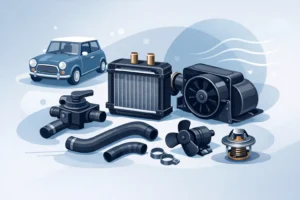
Cooling matters even more once you start asking more of the engine. Uprated radiators, hoses, water pumps and cooling-related hardware are not the most exciting items in a basket, but they protect everything else you have spent money on. If your Mini spends time in traffic, runs a tuned engine or sees hard summer use, cooling should be high on the list.
Suspension upgrades that suit the car
A Classic Mini earns its reputation in the corners, so suspension upgrades need just as much thought as engine work. The trick is to improve control without making the car skittish or unpleasant.
Fresh dampers, cones, bushes and suspension joints can make a tired Mini feel transformed before you even start fitting overtly uprated parts. Many cars benefit more from replacing worn components than from jumping straight to the firmest kit available. Once the basics are right, adjustable dampers, quality suspension kits and geometry corrections can sharpen turn-in and improve stability.
Ride height and alignment are part of the picture too. A Mini that sits badly or has poor geometry will never feel right, however many parts are fitted. Set up properly, even a road-biased suspension package can make the car feel eager and precise. Set up badly, a more expensive arrangement can feel nervous and inconsistent.
Bushes, tie bars and handling balance
Poly bushes are a common upgrade, but there is a trade-off. They can tighten up response and reduce unwanted movement, though in some positions they may also increase harshness or noise. For a road car, it is worth being selective rather than assuming every bush should be replaced with the hardest available option.
The same goes for tie bars and anti-roll solutions. They can improve control, but if the rest of the suspension is not balanced around them, the car may become less forgiving. A Mini that feels confidence-inspiring on real roads is often quicker to enjoy than one built around stiffness for its own sake.
Brakes should match the pace
Performance is not just about going faster. It is also about having the confidence to carry speed and slow the car repeatedly without drama. Uprated pads, discs, hoses and related braking components can bring a genuine improvement, especially on cars that now produce more power than standard.
Not every Mini needs a huge brake conversion. For many road cars, a well-maintained system with quality components is enough. For harder use, increased stopping power and resistance to fade become more relevant. Again, think about the whole package. Tyres, suspension and brake feel all influence how much confidence the car gives you.
Tyres and wheels make a bigger difference than most expect
If there is one area that owners sometimes underestimate, it is tyres. You can spend heavily on engine upgrades, but poor tyre choice will blunt the result. Good rubber improves traction, braking and steering feel in one hit.
Wheel choice matters because it affects tyre options, unsprung weight and ride quality. Larger wheels may change the look, but they are not always the best answer for a Classic Mini that is driven properly. There is usually a sweet spot where grip, feedback and practicality meet, and it is not always the most fashionable setup.
Reliability first, then power
The strongest fast-road Minis are usually the ones built on sound foundations. Before chasing more bhp, check the health of the engine, transmission and driveline. Oil leaks, tired mounts, weak cooling, sloppy linkage and worn joints all reduce the benefit of performance upgrades.
This is where buying from a specialist makes a difference. You want parts that are right for the model, the engine configuration and the intended use. There is no point fitting an uprated component if its fitment is wrong, its quality is poor, or it creates extra work further down the line. That is why many owners prefer a proper Mini-focused supplier such as Bull Motif Mini Spares rather than trying to piece a build together through general listings.
Build the Mini you want to drive
There is no single best catalogue of mini performance parts because the best setup depends on the car and the owner. Some people want a crisp 998 that feels lively on country roads. Others want a torquey 1275 for fast-road use, or a more serious package for motorsport. All can be right if the parts are chosen as a matched combination.
If you are planning upgrades, be honest about how the Mini will be used most of the time. Spend where it counts, keep the setup balanced, and do not neglect the supporting parts that make performance reliable. A well-sorted Classic Mini does not need to be extreme to feel special. Usually, the best cars are the ones that start, stop, corner and pull cleanly every time you ask them to.