A Classic Mini rarely asks for just one part. A routine service can reveal a tired radiator hose, a weeping wheel cylinder or an exhaust mounting that has seen better days. That is why buying minispares properly matters: the right parts order keeps the car usable, avoids repeat strip-downs and gives you confidence in the work once it is back on the road.
The Mini is simple in layout, but it is now an ageing classic with decades of variations, previous repairs and model-specific details to consider. Whether you are maintaining a well-used saloon, rebuilding a Cooper replica or finishing a full restoration, the sensible approach is to buy for the job in front of you – and check the related components while access is easy.
Start with the Mini’s age, specification and use
Before adding parts to a basket, establish exactly what you are working on. The year is useful, but it is not always enough. Minis have often been modified, re-shelled or fitted with later engines, brakes and suspension during their lives. A 1970s car may have front discs from a later model, a 1275cc engine, electronic ignition and a different carburettor arrangement from standard.
Check the chassis number where possible, identify the engine size and look closely at the components already fitted. Measure brake discs, note the number of clutch master cylinder outlets and compare the shape of hoses, mounts and brackets. Photographs taken before dismantling are just as valuable as a workshop manual, particularly around the engine bay, front subframe and interior trim.
How you use the Mini should guide the quality and specification you choose. A concours restoration may call for period-correct details and original-style finishes. A daily driver benefits from dependable service parts, sensible cooling upgrades and good weather sealing. For fast-road or competition use, the priorities may shift towards braking, suspension geometry, oil control and stronger driveline components. There is no single best part for every Mini – there is a suitable part for the way your car is built and driven.
Minispares worth replacing together
The most frustrating repairs are the ones that have to be repeated because an inexpensive adjoining part was left behind. When working on a Classic Mini, treat each system as a group rather than a collection of isolated items.
Servicing the engine and ignition
An oil and filter change is a straightforward starting point, but it is worth inspecting the sump plug washer, oil pressure switch area, breather hoses and rocker cover gasket at the same time. If the engine has been standing, fresh oil alone will not cure every issue. Perished fuel hose, a blocked fuel filter, weak ignition leads and old coolant can all cause faults that are mistaken for a more serious engine problem.
For ignition work, match components to the distributor and set-up fitted to the car. Points, condenser, cap and rotor arm suit a conventional system; electronic ignition needs compatible components and correct wiring. If you are chasing poor starting or misfires, check the basics before buying performance parts: plug condition, timing, earth straps and fuel delivery. A Mini with a sound standard ignition system will usually run better than one with a collection of mismatched upgrades.
Cooling and hoses
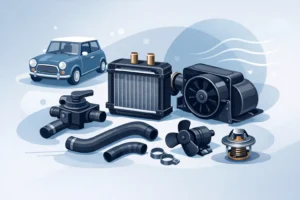
Overheating is a common concern, especially in traffic or on a modified engine. Start by checking the radiator core, cap, thermostat, fan belt and water pump, then look at every hose and clip. A new top hose is of limited use if the bottom hose is soft, the bypass hose is cracked or the clips cannot hold pressure.
Cooling upgrades can be worthwhile, but they are not a substitute for diagnosing the problem. An uprated radiator or electric fan may help a tuned Mini or a car used in heavy traffic. On a standard car, correct ignition timing, a healthy radiator and a properly functioning thermostat often make the bigger difference. Avoid removing the thermostat simply to mask an issue: the engine needs to reach and maintain the right operating temperature.
Brakes, hubs and steering
Brakes are an area where condition and compatibility matter more than appearances. When replacing pads or shoes, inspect discs or drums, flexi hoses, wheel cylinders, calipers, bearings and the state of the brake fluid. Fluid that is old or contaminated can reduce pedal feel, while a swollen flexi hose can cause a brake to bind even when the rest of the system looks sound.
Do not assume every brake part fits every Mini. Drum and disc set-ups differ, as do master cylinders, servo arrangements and wheel cylinder sizes. If you are converting from drums to discs, plan the complete system, including hubs, driveshafts, brake lines, wheels and tyres. It can be a worthwhile safety and usability improvement, but only when the parts work together and are fitted correctly.
Steering and suspension deserve the same joined-up approach. Worn tie-rod bushes, ball joints, rack gaiters and suspension cones can make a Mini feel vague or unsettled. Replacing one component may expose wear elsewhere, so check the whole front end before booking wheel alignment. Once bushes, arms or ride height have changed, a proper geometry check is money well spent.
Body panels: fit is only the beginning
Rust repair is where parts choice can save considerable time. Floors, sills, scuttle corners, door steps and front-end panels may look like simple replacements, but their fit affects panel gaps, water drainage and the strength of the finished repair. Good-quality panels are easier to position and generally require less reshaping, which matters when labour is a large part of the job.
British Motor Heritage panels are often the preferred choice for major restoration work because accurate pressing and fit can make a real difference. That does not mean every repair needs the most expensive option. A small localised patch can be appropriate where the surrounding metal is solid and the repair can be properly welded, protected and finished. The key is not to plate over corrosion or use filler to hide poor panel alignment.
When tackling bodywork, order the associated items early. That might include seals, clips, finishing strips, captive nuts, bumpers, lamp fittings or hinge hardware. Trial-fit panels and doors before paint whenever possible. A neat panel gap is far easier to achieve in bare metal than after the final coat has gone on.
Choose upgrades that solve a real problem
Classic Mini upgrades are appealing because the parts catalogue is full of proven improvements. The best upgrades, however, are those that suit the rest of the car. A larger carburettor without the correct needle, exhaust and engine specification may not improve driveability. Stiffer suspension can sharpen turn-in, but it may make a road Mini tiring on poor surfaces if dampers and ride height are ignored.
Think in systems. A performance cylinder head may require suitable fuelling, ignition timing and cooling. Wider wheels may need careful tyre selection, arch clearance and attention to steering geometry. A freer-flowing exhaust should fit the manifold, hangers and rear subframe arrangement correctly. Buying parts from a Mini specialist helps because the catalogue is organised around how these systems actually go together, rather than treating the Mini as just another old car.
Bull Motif Mini Spares is built around that practical approach, covering the service items, restoration panels, trim, engine components and upgrades that owners commonly need in the same project. It makes it easier to gather the small but essential fittings that can otherwise hold up a weekend in the garage.
Check quality, quantity and the small fittings
A low price is not always poor value, and a higher price is not automatically proof of quality. Consider where the part is used and what failure would mean. Consumables such as gaskets, filters and clips should be good quality, but brake, steering, fuel and cooling parts deserve especially careful selection. Read the description, confirm whether the item is sold individually or as a pair, and check whether seals, bolts or fitting kits are included.
Keep old components until the new ones are fitted and verified. They are useful for comparing lengths, threads, connector styles and mounting positions. For electrical items, confirm polarity and voltage requirements, particularly if the car has been converted from positive earth to negative earth. For trim and body fittings, count clips and fasteners before beginning. The smallest missing part has an impressive ability to stop progress late on a Sunday afternoon.
Make every job easier to finish
A well-planned parts order is not about buying everything at once. It is about avoiding the known delays. Write down the job, inspect the surrounding parts, add the consumables and allow for the sensible “while you are there” replacements. If you are unsure about fitment, stop and check before dismantling a serviceable component.
The Classic Mini rewards careful maintenance because most jobs are accessible, understandable and satisfying to complete. Buy parts that suit your car, fit them methodically and leave enough time for the final checks. The best result is not merely a Mini that starts after the work – it is one you are happy to take out for the long route home.