A quick Mini with the wrong parts is usually just an expensive way to find weak spots. That is why classic mini competition upgrades need to be planned as a package, not bought one shiny bit at a time. Whether you are building for sprints, hill climbs, fast road use or a proper track car, the best results come from matching the engine, brakes, suspension and cooling to the way the car will actually be used.
Where classic mini competition upgrades should start
Most owners begin with the engine because that is where the excitement is. Fair enough. But on a Classic Mini, outright power only works when the rest of the car is ready for it. A lively 1275 with poor damping, tired bushes and marginal brakes will feel nervous and waste performance you have already paid for.
The smart route is to start with the shell and running gear. Make sure the subframes are sound, the mounting points are solid and the steering is tight. If the basics are worn out, competition parts only highlight the problem. There is no point fitting uprated suspension to a car that still has play in the swivels or old rubber that has gone soft and cracked.
Once the car is structurally right, think in terms of balance. A road-going sprint Mini needs a different setup from a circuit car running repeated hard laps. One wants decent ride quality and drivability. The other can accept more noise, more vibration and a much narrower operating window.
Engine upgrades that suit competition use
Classic Mini engine tuning is full of tempting claims, but usable power matters more than headline numbers. On most builds, a well-matched cylinder head, camshaft, carburation or injection setup, exhaust and ignition package will beat a random collection of performance parts.
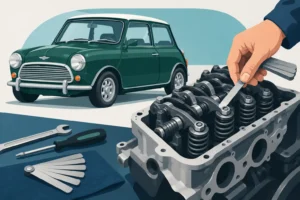
For many owners, the cylinder head is where the best gains are found. Better airflow improves the whole character of the engine, especially when it is matched to the right cam. Go too wild with the camshaft, though, and the car becomes peaky, lumpy at idle and less enjoyable outside a narrow rev range. That can be fine for competition, but only if the gearbox ratios and final drive support it.
Compression ratio also needs thought. Higher compression can sharpen response and improve output, but it raises the demand on fuel quality and tuning accuracy. On a hard-used Mini, detonation is not something to gamble with. The more serious the specification, the more important it becomes to build the engine properly rather than chase figures.
A free-flow exhaust manifold and system are common upgrades for good reason. They help the engine breathe and usually work well with head and cam improvements. The key is choosing a system that suits the build. A big-bore setup on a modest engine does not always help. Sometimes it simply moves the power higher up the range and makes the car feel flatter where you actually use it.
Cooling should sit in the same conversation as power. A tuned A-Series that runs hot will not stay quick for long. Uprated radiators, quality hoses, a reliable water pump and an efficient cooling setup matter just as much as the performance parts bolted to the top end.
Gearbox and transmission upgrades are not optional
If there is one area that gets overlooked on classic mini competition upgrades, it is the transmission. The standard gearbox can cope with a lot when it is in good condition, but competition use quickly exposes weak synchromesh, worn bearings and poor ratio choices.
Close-ratio gear sets can keep a tuned engine in its power band, especially in sprint and circuit work. Straight-cut gears reduce some losses and are popular on more focused builds, but they bring more noise. For a road-based car, that matters. For a competition Mini, it may be a trade-off worth making.
The differential deserves equal attention. A limited-slip differential can transform traction on corner exit, particularly with a stronger engine. That said, it can also alter the steering feel and make the car more demanding at low speed. Not every owner will want that on the road. If the car sees mixed use, be honest about how much compromise you are prepared to live with.
Do not ignore the clutch either. A stronger clutch setup is often needed once torque rises, but an overly heavy clutch can make the car tedious in traffic and harder on drivetrain components. Again, the right answer depends on the job.
Brakes need to match the pace
There is no glamour in saying it, but brakes are where many successful builds are won. The right classic mini competition upgrades for braking usually start with condition and consistency. Good discs, quality pads, sound callipers, fresh rear cylinders where applicable, braided hoses and decent fluid make a far bigger difference than most people expect.
For faster road and light competition use, a well-sorted disc setup with a proven pad compound is often enough. Once speed and heat build up, larger or uprated brake packages start to make sense. The important thing is pedal feel and repeatability. Big brakes that never get worked properly can feel wooden, while an underspecified setup will fade just when you need confidence.
Brake bias is another point worth respecting. The Mini is light, short-wheelbase and sensitive to changes. More front brake is not always better if it upsets the balance. A car that dives into corners well but locks the fronts too easily is not faster.
Suspension and handling upgrades that genuinely help
A Classic Mini should feel eager, direct and planted. The best handling upgrades sharpen that character rather than fight it. Competition dampers, quality bushes, adjustable suspension components and proper alignment can make a car feel completely different without touching the engine.
Rubber cones, trumpets and dampers need to be chosen as a set. Very stiff setups can work on smooth surfaces, but the UK does not offer many of those outside proper venues. A Mini that skips over bumps loses grip, even if it feels dramatic. For hill climbs, B-roads and mixed surfaces, a compliant but controlled setup is often quicker.
Negative camber and toe settings can improve turn-in, but extremes rarely help a dual-purpose car. Tyre choice also has a huge influence. There is little sense spending heavily on suspension while fitting tyres that cannot support the package. If you are chasing lap times, tyres are one of the most important decisions on the car.
Solid mounts and extra stiff bushes can improve precision, but they also increase harshness and noise. Some owners love that direct feel. Others regret it after half an hour on the road. It is worth deciding early whether the build is a competition car that can use the road, or a road car with competition flavour. That distinction saves money.
Weight, safety and shell preparation
Power upgrades get attention, but reducing weight is one of the oldest and most effective ways to make a Mini faster. Less mass improves acceleration, braking and turn-in all at once. It also reduces the load on tyres and suspension.
That does not mean stripping everything without a plan. Removing weight from high up in the shell helps more than losing the same amount lower down. Seats, interior trim, glass choices and wheel selection all affect the result. So does where the remaining weight sits.
Safety upgrades are non-negotiable once the car moves beyond spirited road use. Proper seats, harnesses, fire safety equipment and roll-over protection should be viewed as core competition parts, not extras to add later if funds allow. Shell strengthening can also be worthwhile, particularly on older cars that will see sticky tyres and harder cornering loads.
Choose upgrades as a package, not as individual bargains
The temptation with classic mini competition upgrades is to buy whatever appears to be good value at the time. Most experienced owners learn the same lesson sooner or later – mismatched parts cost more in the long run.
A fast-road head with a full-race cam, standard gearing, soft suspension and budget tyres is not a package. Neither is a large brake kit on a car with tired rear suspension and old steering joints. The Mini responds brilliantly to upgrades, but only when they work together.
This is where using a specialist supplier makes life easier. The right parts are not just the ones that fit. They are the ones that suit your engine size, intended use, wheel choice and budget. Bull Motif Mini Spares serves exactly that kind of owner – someone who wants the job done properly, with components chosen around the real car rather than a generic wish list.
Build for the way you drive
There is no single best specification because competition means different things to different owners. A hill climb Mini wants instant response and agility. A track day car needs cooling, braking and consistency. A fast-road Mini benefits from restraint as much as ambition.
The best builds tend to be the ones with a clear purpose. Start with reliability, make the chassis trustworthy, then add power that the car can use. If each upgrade solves a real need, the finished Mini will not only be quicker – it will feel better every time you turn the key.
A good competition Mini is never just about having more parts. It is about choosing the right ones, fitting them properly and ending up with a car that works as hard as you do.